Deploy CloudAEye Code Review On Premises
July 17, 2026. 10 min
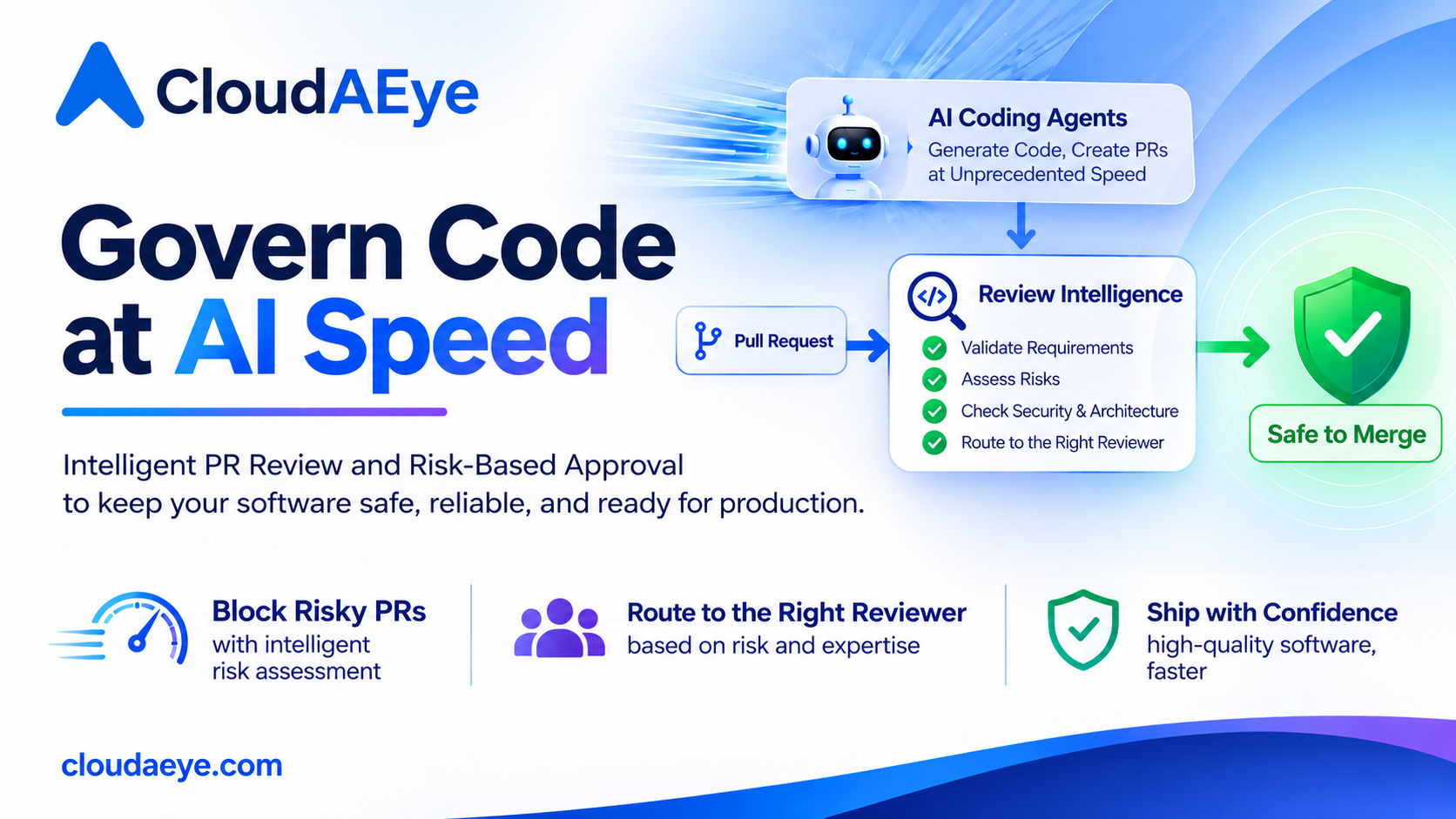
AI has solved one of software engineering’s biggest bottlenecks: writing code. Now it is creating another one: proving the code is correct.
Coding agents can generate implementations, write tests, fix bugs, and create pull requests at unprecedented speed. But producing code is only one part of software engineering. Before that code reaches production, teams still need to understand it, validate it, assess its risks, and decide whether it is safe to merge.
And that is where the bottleneck is shifting.
A new industry report analyzing two years of telemetry from 22,000 developers across more than 4,000 teams reveals a fascinating picture of AI-assisted software development. On the productivity side, the results are impressive:
AI is helping engineering teams accomplish more. Developers can tackle larger initiatives, complete tasks faster, and move code through the development pipeline at a higher rate. But look at what happened downstream. The same report highlights significant increases in several indicators of engineering risk and review pressure:
These numbers raise an uncomfortable question:
Are we accelerating software delivery faster than we can validate the software we deliver?
The findings suggest a growing tension. AI is making it easier to produce code, but more code does not automatically mean better software. Increased throughput can come with more rework, greater review demands, and new challenges in maintaining quality and reliability.
This is the AI acceleration paradox: the very technology that helps engineering teams move faster can overwhelm the processes they rely on to ship software safely.
For decades, software engineering teams worked to reduce the time required to write, debug, and test code. Developer productivity was closely tied to how quickly engineers could turn requirements into working software. Coding agents are changing that equation.
An agent can generate hundreds or thousands of lines of code, modify multiple files, implement an issue, and open a PR in a fraction of the time it might take a developer to do the same work manually. But the code still needs to be validated.
Does the implementation satisfy the original requirements? Are there subtle bugs or security vulnerabilities? Does the change introduce architectural problems? Could it affect other services or repeat a failure that the organization has already experienced? These questions become more difficult when the volume and complexity of changes increase.
Human reviewers have limited time and attention. They cannot indefinitely absorb more PRs, larger diffs, and more complex changes simply because coding agents can generate them faster. The result is a growing imbalance between code production and code validation.
The bottleneck is shifting from writing code to reviewing, validating, and trusting code. There are three emerging challenges:
This is not just a theoretical concern. Another industry report found that 47.7% of engineering leaders identified reviewing and validating the right AI-generated code at scale as their biggest quality and governance gap.
The challenge is not simply reviewing every line of code. It is determining which changes deserve the most attention, which findings represent genuine risks, and what evidence is needed before a change can be approved.
Traditional code review workflows were not designed for a world in which coding agents continuously generate large volumes of changes. When every PR follows roughly the same review process, teams face two undesirable outcomes.
First, low-risk changes consume valuable reviewer time that could be spent on more consequential work. Second, high-risk changes can get lost in a crowded review queue or be approved without sufficient scrutiny.
Adding more human reviewers may provide temporary relief, but it does not fundamentally solve the problem. Engineering teams need a smarter way to review and govern code at the pace AI produces it.
AI-powered code review tools can help identify bugs, explain code changes, and suggest improvements. These capabilities are valuable, but the next challenge goes beyond generating review comments. Engineering teams need to connect code analysis to the broader context in which software is developed and operated.
Consider a PR that modifies payment processing across several services. A conventional review may identify potential defects in the code. But an effective engineering workflow should also ask:
Not every PR carries the same risk. A documentation update should not necessarily receive the same level of scrutiny as a change to authentication, payment processing, or a critical production service.
The future of code review is not just finding more bugs. It is applying the right level of scrutiny to the right changes and governing their path to production.
That requires a combination of intelligent code analysis, risk-based prioritization, and configurable approval policies.
CloudAEye Review Intelligence brings intelligent PR review and risk-based approval directly into developers' coding-agent workflows.
It works alongside tools such as Claude Code, Codex, Cursor, VS Code, IntelliJ IDEA, and PyCharm, helping engineering teams validate code, prioritize risk, and apply governance without abandoning their existing development environments.
The goal is straightforward: help teams ship code with confidence, even as AI dramatically increases the volume of code they produce.
Review Intelligence focuses on three connected capabilities.
Code review needs to consider more than the lines changed in a PR.
Review Intelligence helps teams examine changes for potential correctness, quality, security, and architectural issues. It can also help validate implementations against their associated tasks and acceptance criteria.
This connects the code being submitted to the reason it was written in the first place.
The result is a more context-aware review process that helps teams identify incomplete implementations and potential defects before they reach production.
When dozens or hundreds of PRs enter an engineering pipeline, treating every change equally is inefficient.
Review Intelligence provides PR triage and risk assessment capabilities that help teams identify which changes deserve attention first.
Signals such as risk, complexity, and business impact can help distinguish routine changes from those that warrant deeper investigation. Relevant bug and incident history can provide additional context for review decisions.
For example, a change affecting a critical payment service and multiple dependent services may deserve more scrutiny than a small, isolated refactoring.
By making risk more visible, teams can direct limited reviewer attention toward changes with the greatest potential consequences.
Identifying a potential problem is only part of the process. Engineering teams also need a consistent way to decide whether a PR is ready to merge.
Review Intelligence supports configurable review and approval workflows that combine automated checks, governance policies, and human oversight.
Depending on the configured policy and risk level, a change can undergo automated validation, review by a designated human, or additional approval steps.
This helps organizations move beyond a simple approve-or-reject decision toward a more deliberate process in which approval requirements reflect the risks involved.
Automation handles repeatable validation where appropriate, while human reviewers remain involved when judgment, expertise, or additional accountability is required.
Here are the core features of review intelligence.
The distinction matters.
A traditional code review tool primarily helps reviewers identify potential issues in a change. A code governance workflow also helps determine what should happen after those issues are identified.
Review Intelligence connects these activities:
This creates a more consistent path from code generation to merge.
It also addresses a fundamental challenge of AI-assisted development: teams need confidence not only that code has been generated, but that the code has been evaluated against the requirements, risks, and standards that matter to their organization.
No automated system can prove arbitrary software correct in every possible context. But combining automated analysis, risk-aware policies, and human oversight can make code validation more scalable and disciplined.
That is the role of intelligent code governance in the agent era.
AI coding agents will continue to become more capable. They will generate more code, handle more complex tasks, and participate in increasingly large parts of the software development lifecycle.
Engineering teams should embrace that productivity.
But sustainable acceleration requires more than faster code generation. It requires the ability to validate changes, identify risks, and maintain quality as development workflows evolve.
The next generation of engineering teams will need to optimize not only how quickly code is written, but how confidently it can be shipped.
CloudAEye Review Intelligence is built for this transition, bringing intelligent PR review and risk-based approval into the coding-agent workflow.
Because the goal is not simply to write more code, faster.
It is to govern code at the speed AI writes it.
Explore the CloudAEye Review Intelligence usage guide to learn more about the plugin, its commands, and how to integrate intelligent code review into your development workflow.

A seasoned engineering executive, Nazrul has been building enterprise products and services for 20 years. Nazrul is the founder and CEO of CloudAEye. Previously, he was Sr. Dir and Head of CloudBees Core where he focused on enterprise version of Jenkins. Before that, he was Sr. Dir of Engineering, Oracle Cloud. Nazrul graduated from the executive MBA program with high distinction (top 10% of the cohort) at University of Michigan Ross School of Business. Nazrul is named inventor in 47 patents.
July 17, 2026. 10 min
May 05, 2026. 15 min
Feb 24, 2026. 12 min
Dec 29, 2025. 10 min
Dec 11, 2025. 10 min
May 28, 2025. 12 min

February 21, 2025. 8 min

Feb 04, 2025. 5 min
Dec 17, 2024. 10 min

December 24, 2024. 5 min

Jan 14, 2025. 5 min
February 18, 2025. 12 min
January 10, 2025. 7 min
January 31, 2025. 8 min

March 11, 2025. 8 min