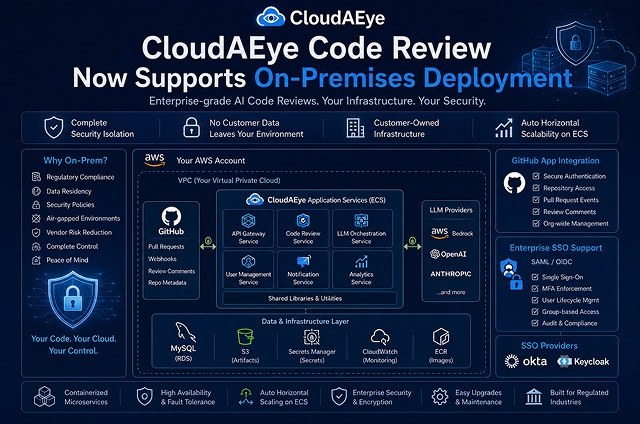
On Premises Deployment for CloudAEye
July 17, 2026. 10 min
CloudAEye integrates AI-powered code review directly into Bitbucket pull requests, helping engineering teams improve code quality, strengthen security, and accelerate software delivery without disrupting existing workflows. By understanding the entire codebase, CloudAEye delivers accurate, context-aware recommendations with fewer false positives.
In addition to automated code reviews, CloudAEye helps developers generate pull request descriptions, implement fixes, create unit tests, and automate repetitive development tasks, enabling teams to deliver secure, maintainable, and production-ready software faster.
CloudAEye is expanding its ecosystem. Today, we are excited to announce full support for Bitbucket, bringing our intelligent Code Review capabilities to thousands of teams that rely on Atlassian's developer platform. With this release, CloudAEye now embeds directly into GitHub, Bitbucket, and VS Code, helping engineers ship high-quality software up to four times faster by automating critical post-coding workflows.
Startups and growing engineering organizations face increasing pressure to deliver reliable software at scale. CloudAEye removes friction from dev-test cycles, eliminates slow review bottlenecks, and surfaces the insights teams need to build with confidence. Recognized by AngelList (Wellfound) as a Top 10 AI Startup and featured in TechCrunch's AI Startup Battlefield, CloudAEye is redefining how modern software teams build, test, and ship.
With Bitbucket support, CloudAEye integrates directly into your pull requests, giving reviewers deep context, intelligent automation, and actionable insights without leaving Atlassian's ecosystem.
Key capabilities now available for Bitbucket teams include:
CloudAEye delivers high-quality, architect-level reviews that detect issues early. Our system understands agentic AI patterns, CNCF stacks, and widely used open-source libraries, producing feedback that aligns with how real engineers reason about code.
Instead of reviewing diffs in isolation, CloudAEye builds a detailed graph of your entire codebase from dependencies to directory structure to internal APIs. This holistic understanding results in more accurate findings, fewer defects, and reviews grounded in real system behavior.
CloudAEye learns your frameworks, languages, infrastructure, and architectural conventions. Every recommendation is tailored to your actual implementation patterns, not generic best practices.
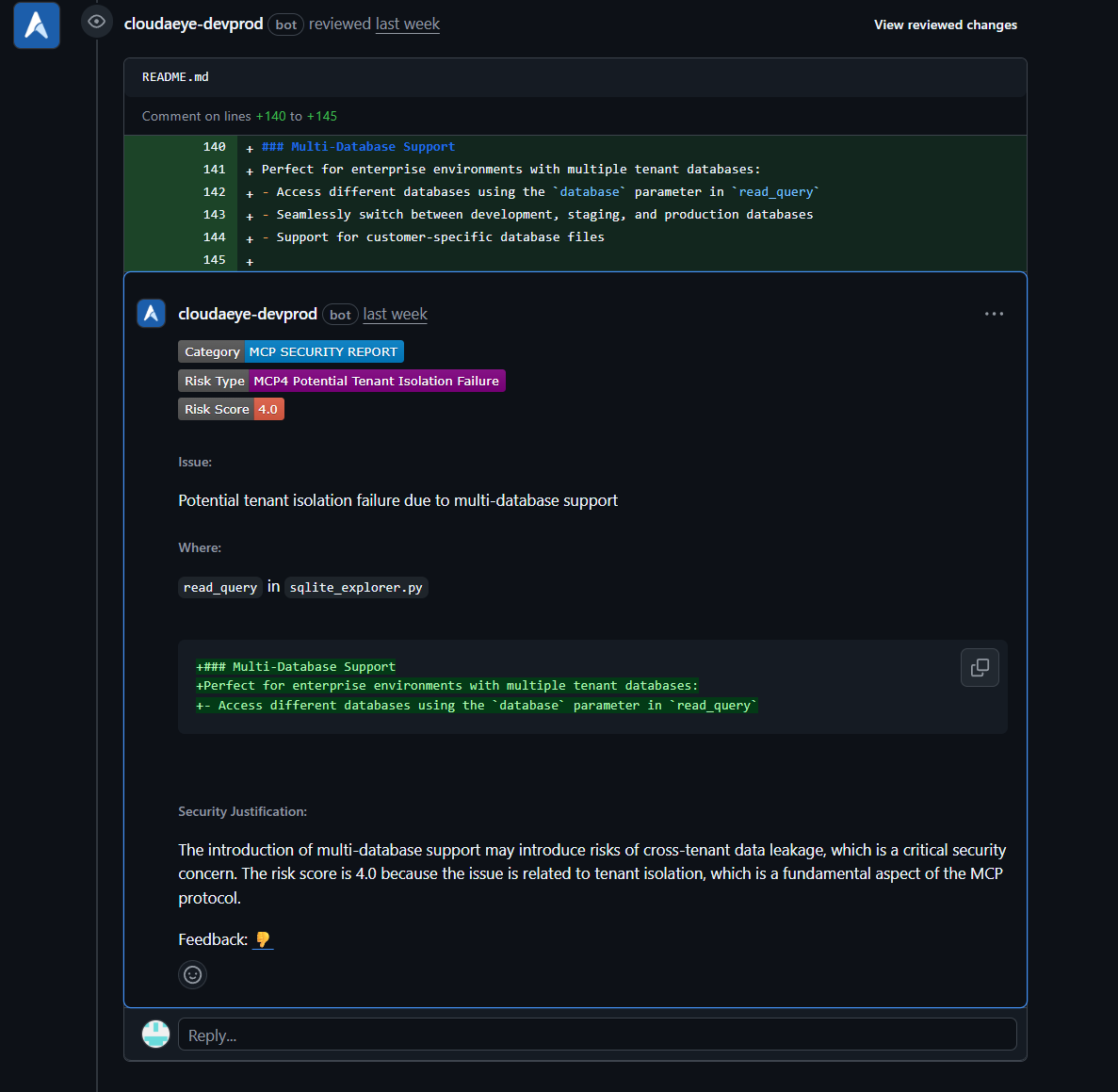
CloudAEye provides a comprehensive, modern security assessment that extends well beyond traditional static analysis. In addition to reviewing code against industry standards such as the OWASP Top 10 and the Agentic Security Initiative (ASI), CloudAEye evaluates repositories for vulnerabilities unique to LLM-powered applications, agentic systems, and MCP-based tooling. This ensures teams building AI-driven applications maintain strong security controls across their entire software and AI infrastructure.
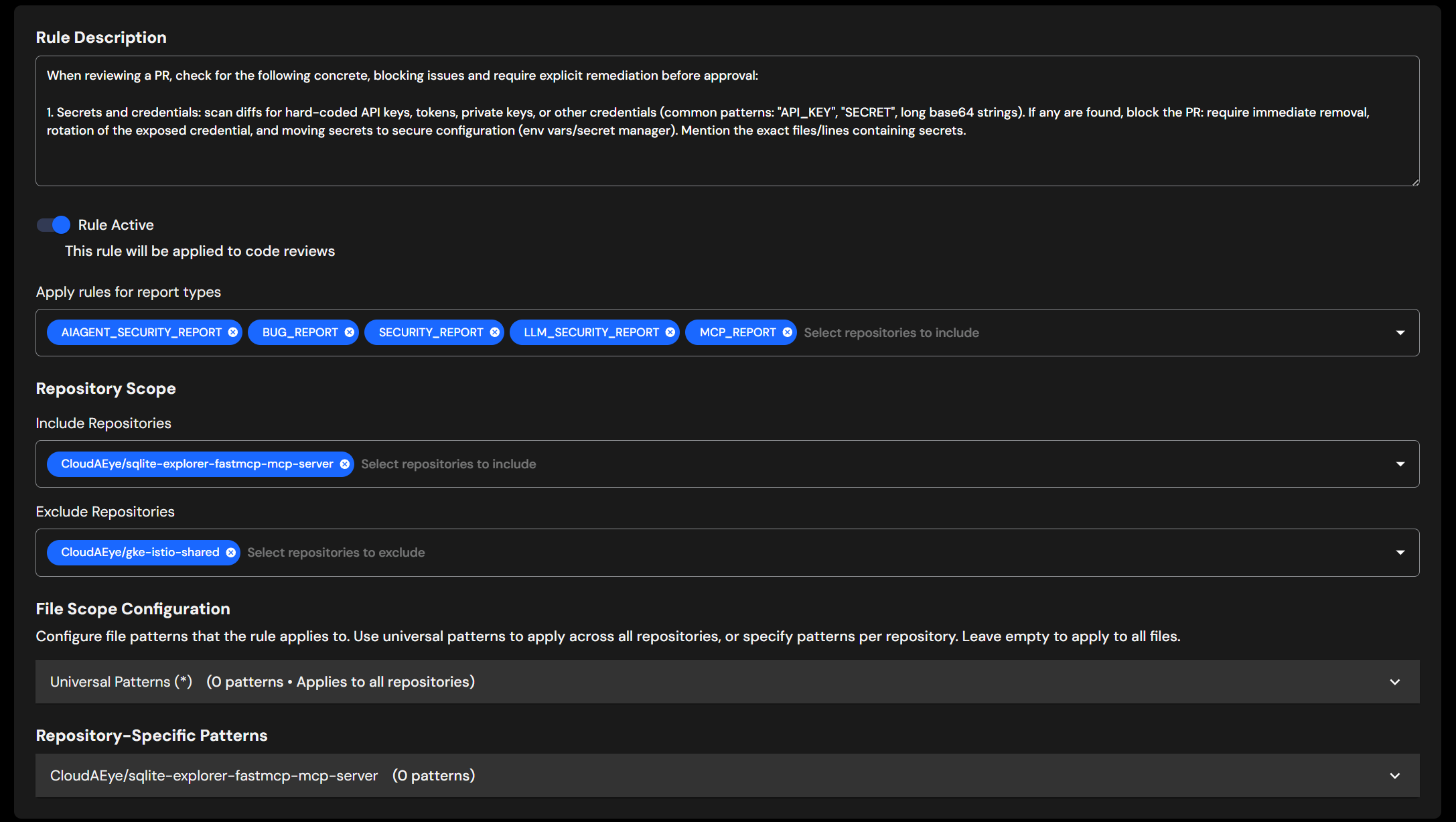
Teams can define their own review standards in plain English. CloudAEye automatically interprets, applies, and scopes each rule, enabling fully personalized reviews that reflect your engineering culture.
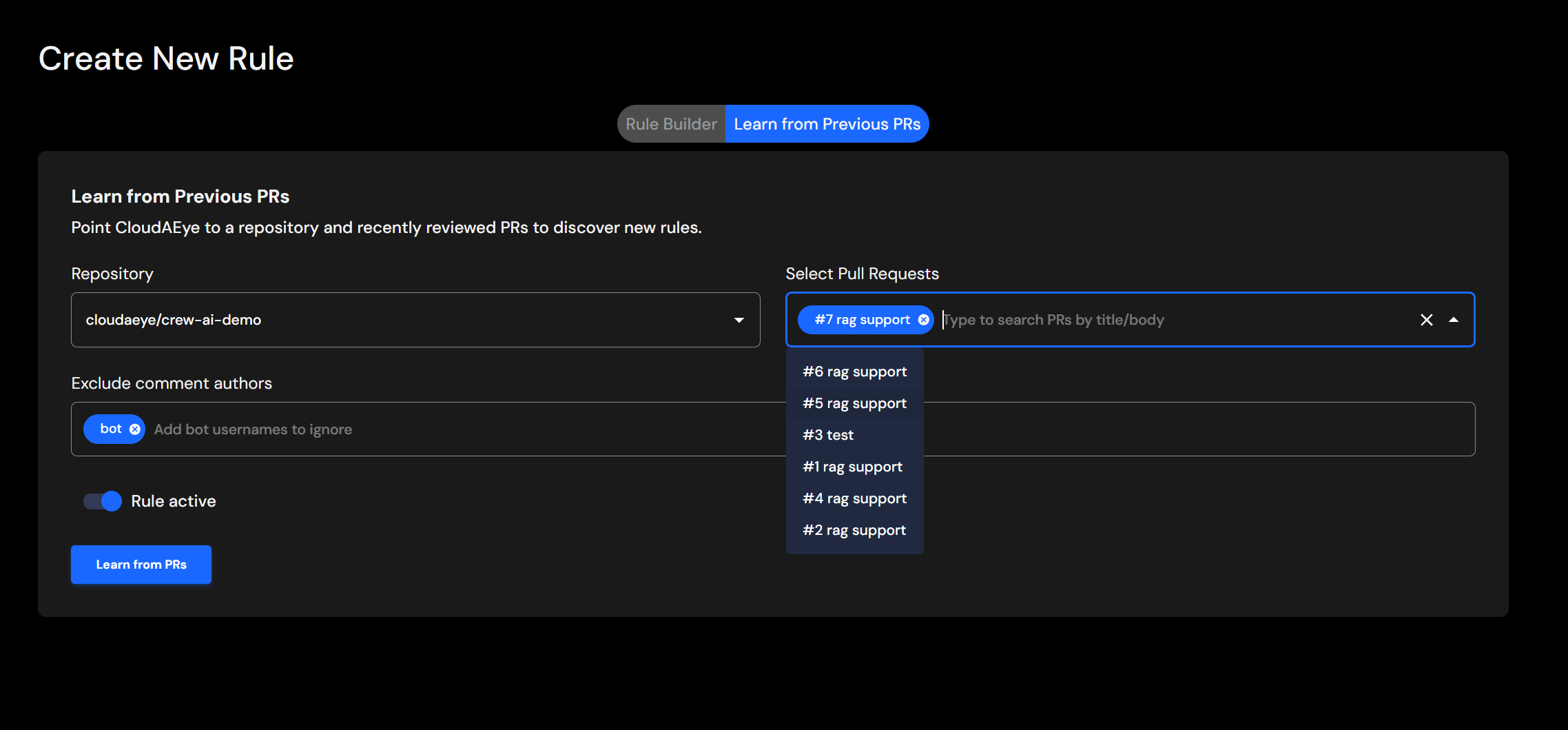
CloudAEye not only adapts to your team's preferences, it actively learns from your organization's review history. By analyzing previously reviewed pull requests, CloudAEye identifies patterns in your team's feedback, style, architectural preferences, and recurring concerns. It then converts these insights into actionable review rules, ensuring that your engineering standards are consistently applied across new code changes.
In addition to historical learning, CloudAEye responds to real-time reviewer input. When an engineer reacts to a review comment, affirming it, dismissing it, or providing direct feedback, CloudAEye interprets that signal and can automatically generate or refine rules based on the reviewer's intent. This transforms incidental reviewer feedback into durable organizational knowledge.
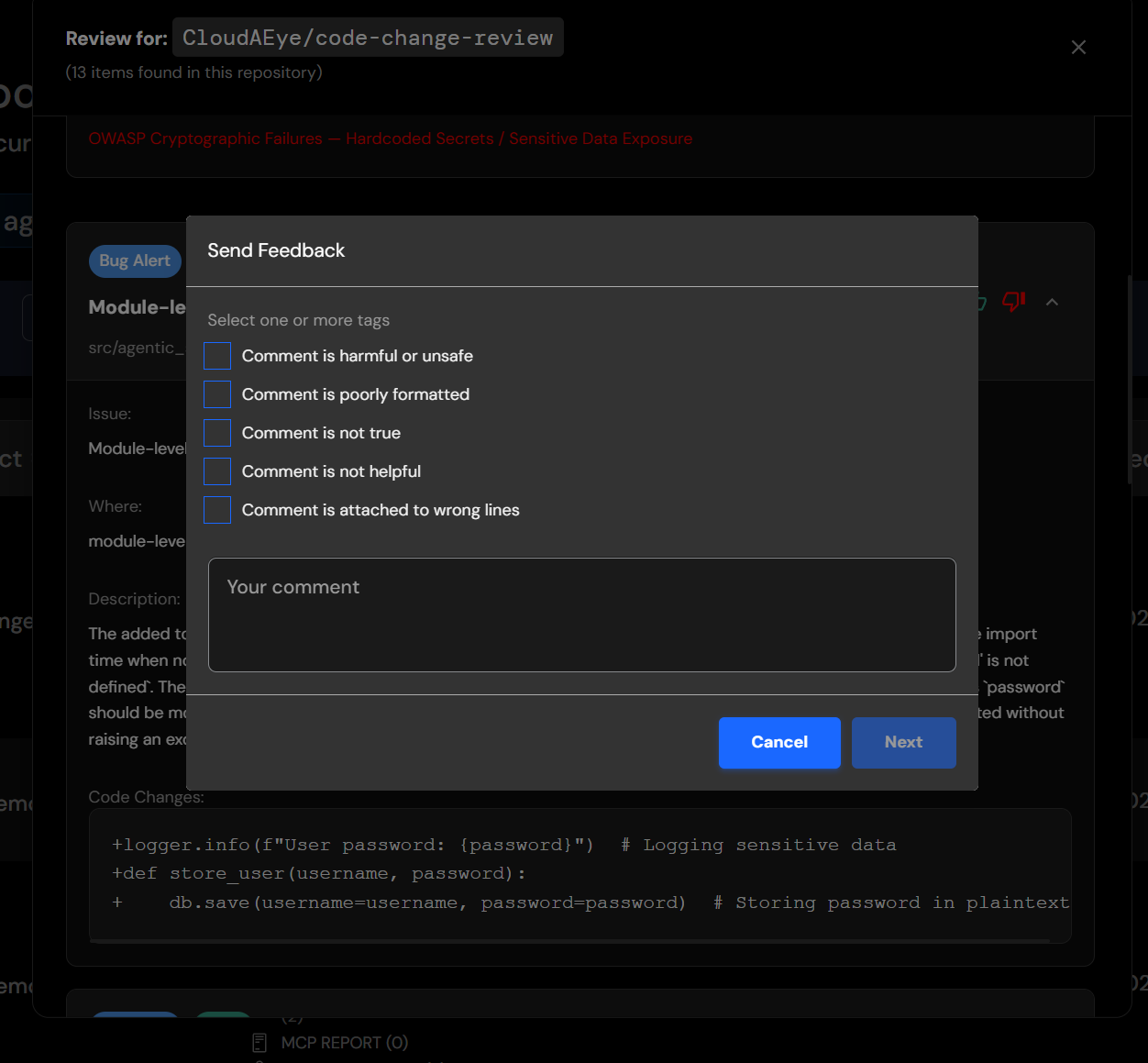
By observing which comments your team accepts or rejects, the system adapts its guidance to match your standards and coding conventions. Over time, CloudAEye evolves into a highly personalized review system that mirrors your team's expectations and coding style, with rules grounded in actual engineering behavior rather than static, generic guidelines.
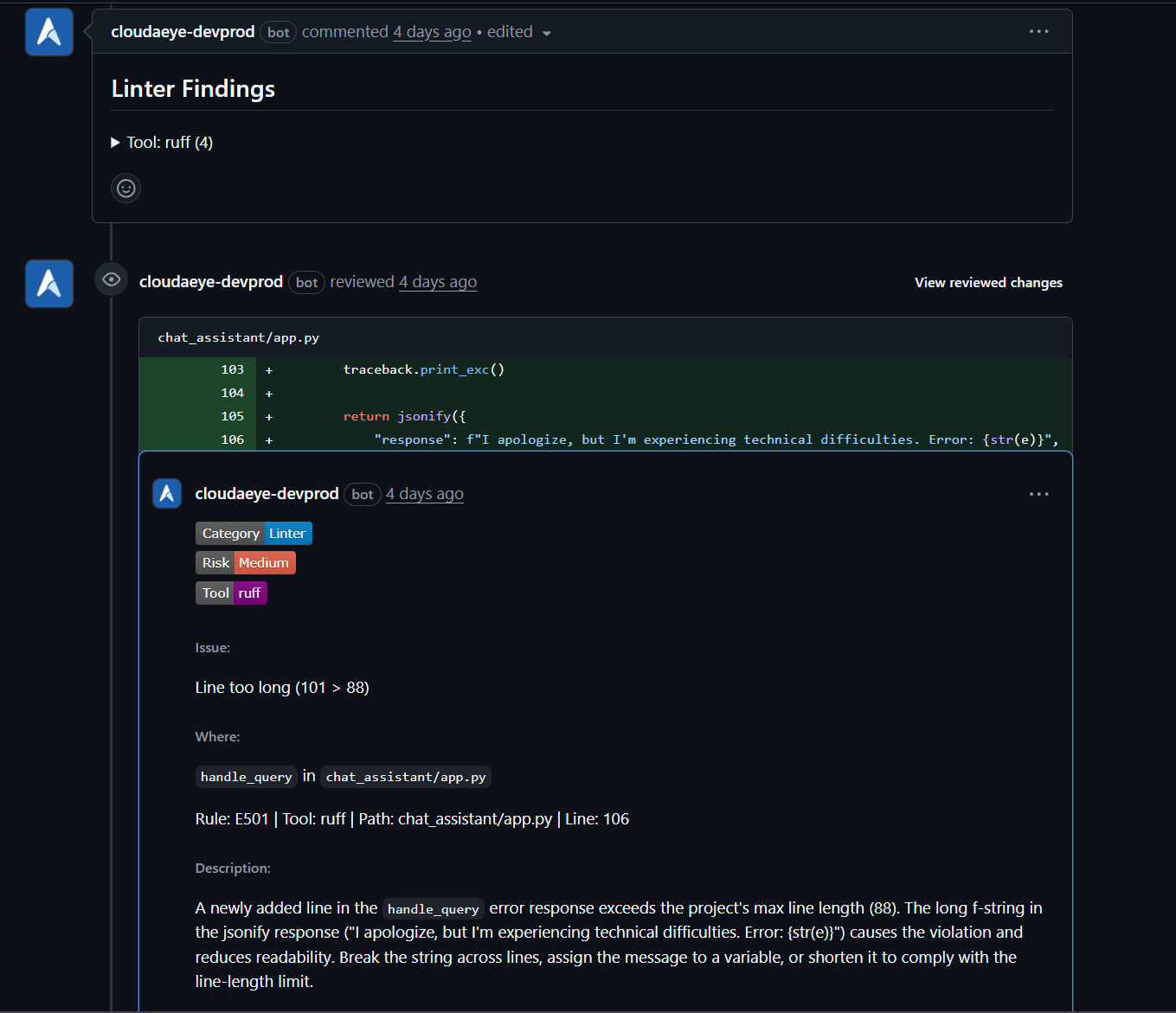
CloudAEye integrates seamlessly with your existing linters, unifying stylistic, structural, and maintainability checks into a single, coherent workflow. Teams can plug in popular tools such as ESLint, Pylint, Flake8, or GolangCI-Lint and CloudAEye automatically incorporates their findings into each review.
Beyond simple integration, CloudAEye supports industry best practices for linter configuration. It guides teams in setting up consistent rule sets, enforcing language-specific conventions, and aligning checks with widely accepted standards across CNCF and open-source ecosystems. This includes baseline configurations (such as ESLint's recommended rules), layered rule profiles for large monorepos, and harmonized settings for multi-language environments.
By centralizing linter output, normalizing rule interpretations, and aligning configurations with modern best practices, CloudAEye ensures your codebase remains clean, readable, and sustainable while reducing the manual overhead typically associated with maintaining linter configurations across multiple repositories.
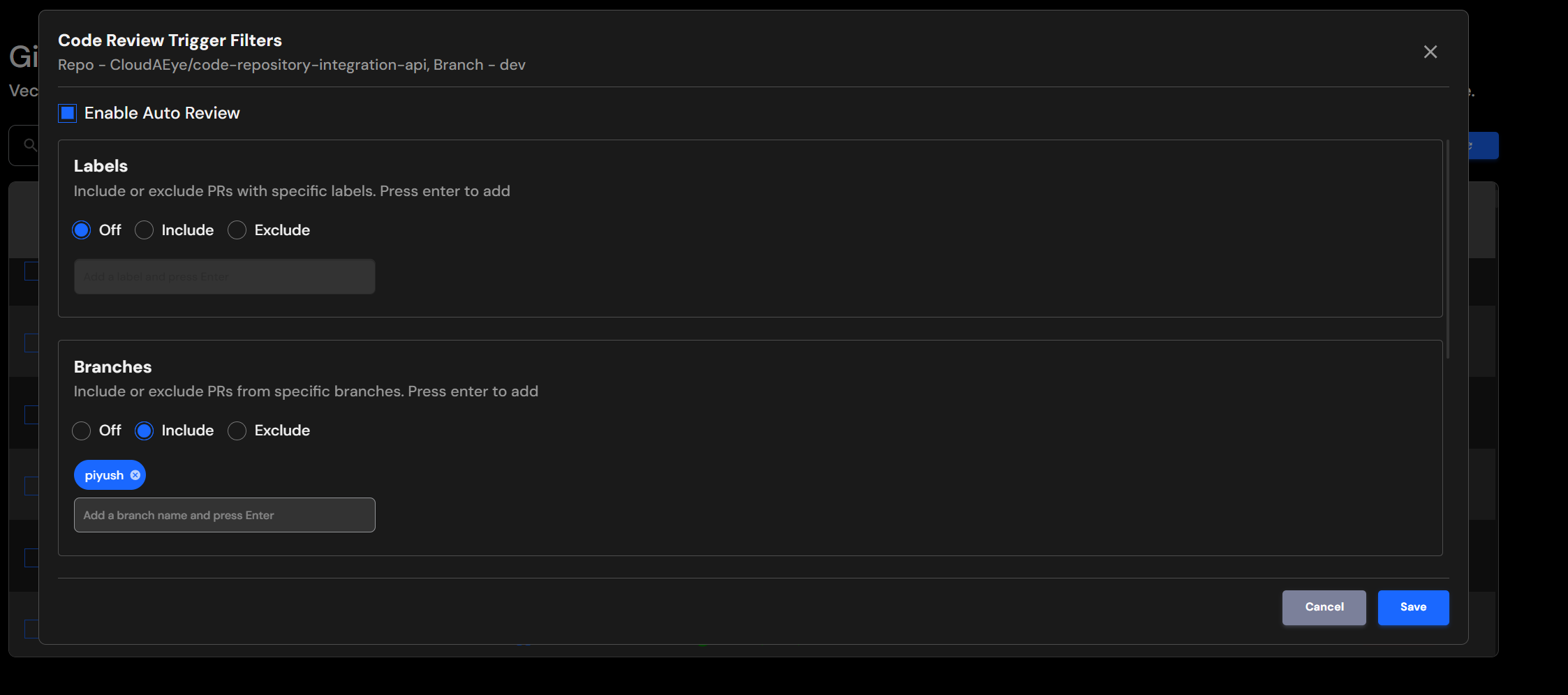
Automatically trigger reviews based on labels, authors, branches, or other filters ensuring every PR receives consistent scrutiny without manual oversight.
Convert any review comment into a Jir or GitHub issue instantly. CloudAEye handles the formatting, linking, and cross-repo references so teams never lose track of follow-ups.
Engineers receive precise code modifications for identified issues, reducing cognitive overhead and accelerating PR turnaround.
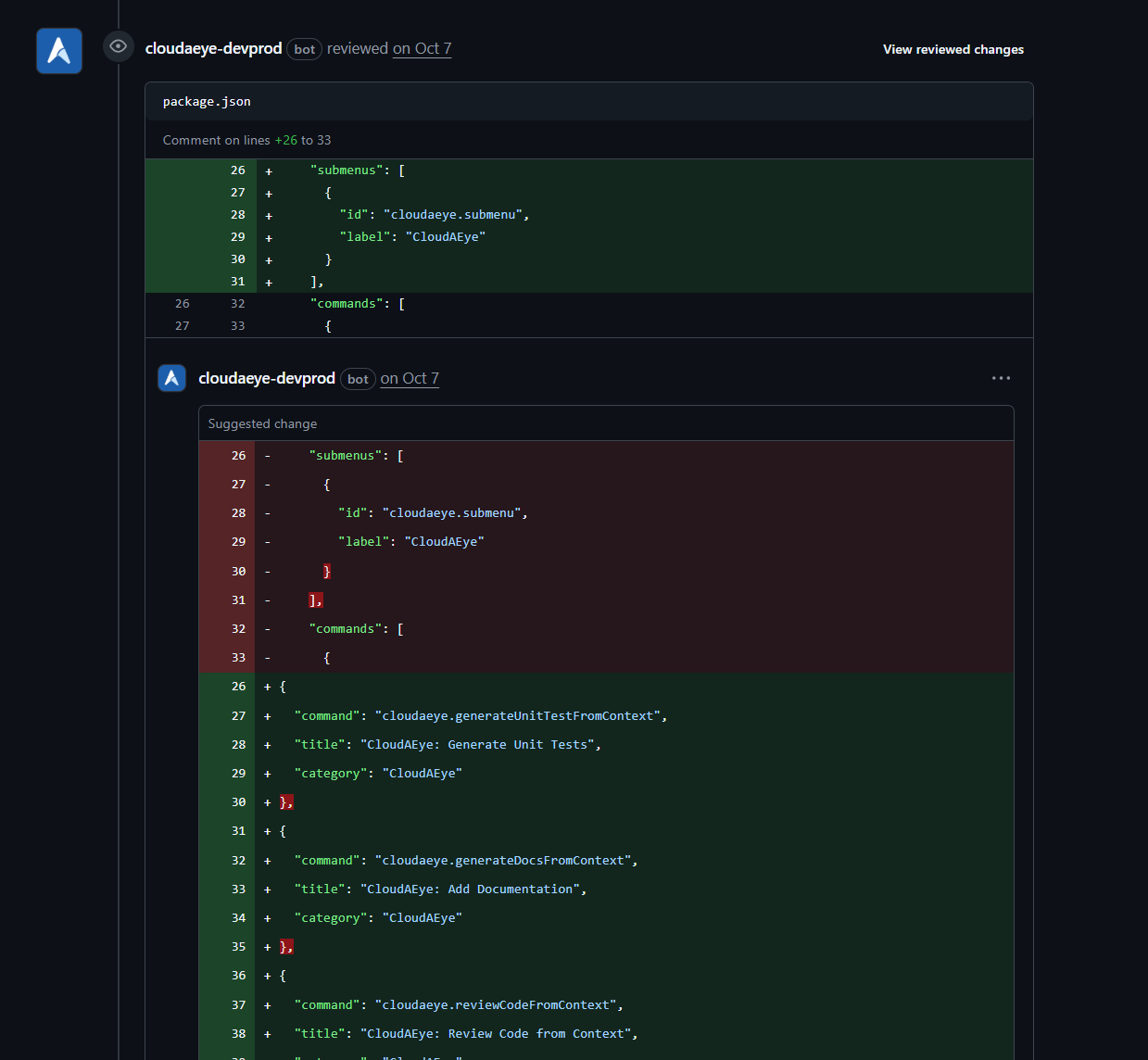
CloudAEye automatically drafts clear, detailed PR descriptions based on the actual code changes.
Generate and update unit tests with every change. CloudAEye covers edge, error, and negative paths to help teams reach full test coverage.
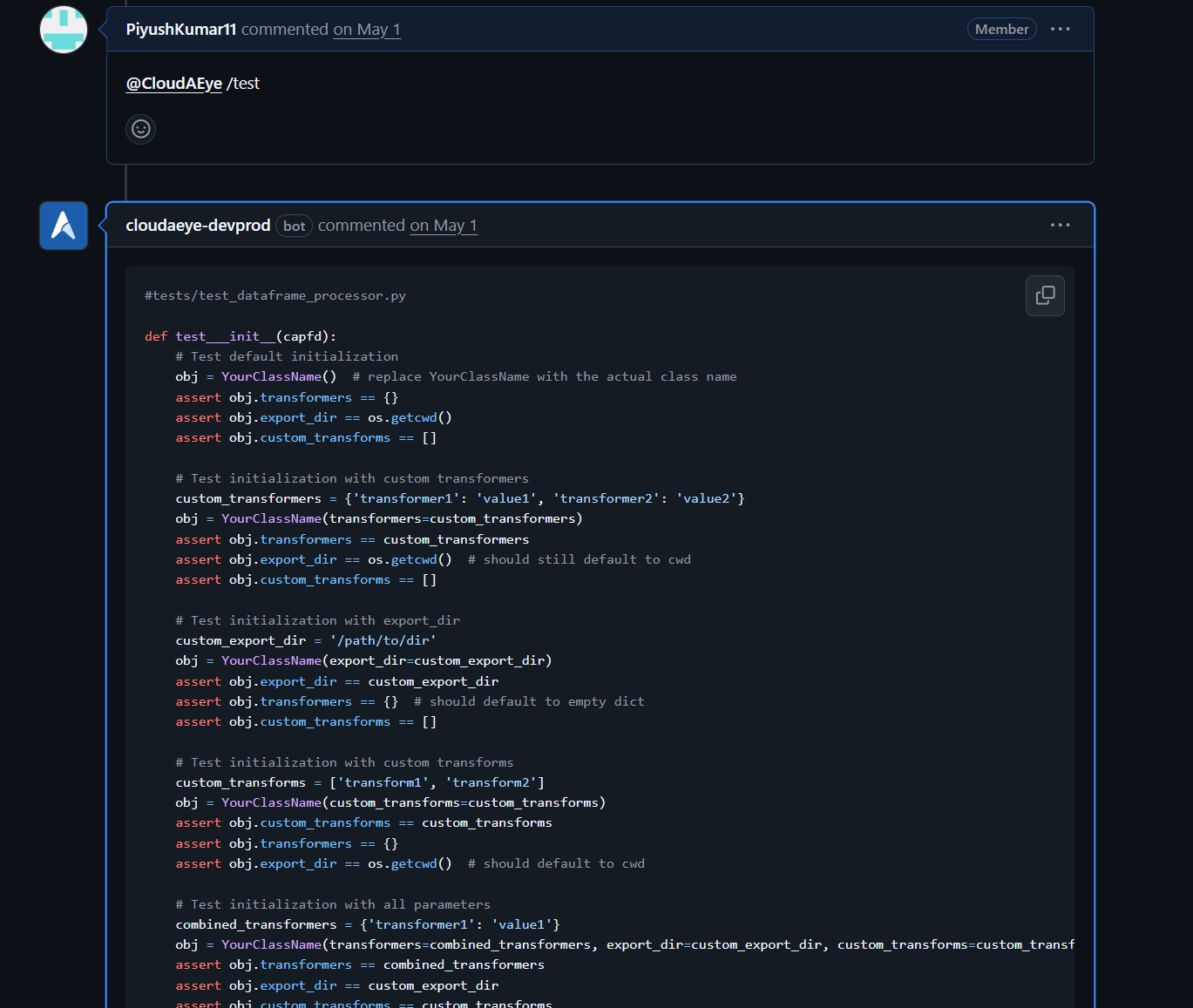
Query and navigate massive enterprise codebases spanning hundreds of repositories with natural questions instead of manual searching.
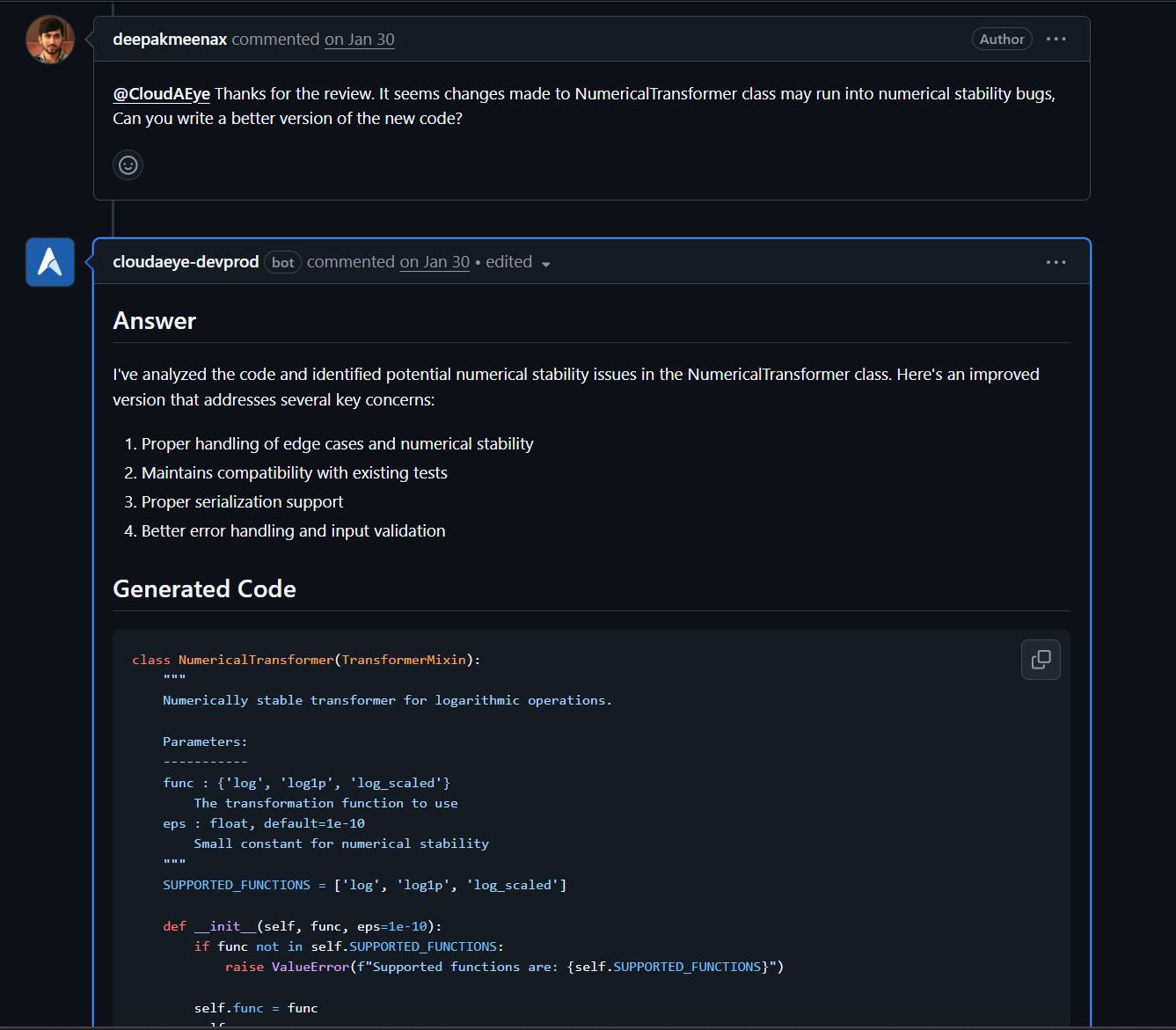
Convert Jira or GitHub Issues into step-by-step implementation guidance, powered by your codebase context.
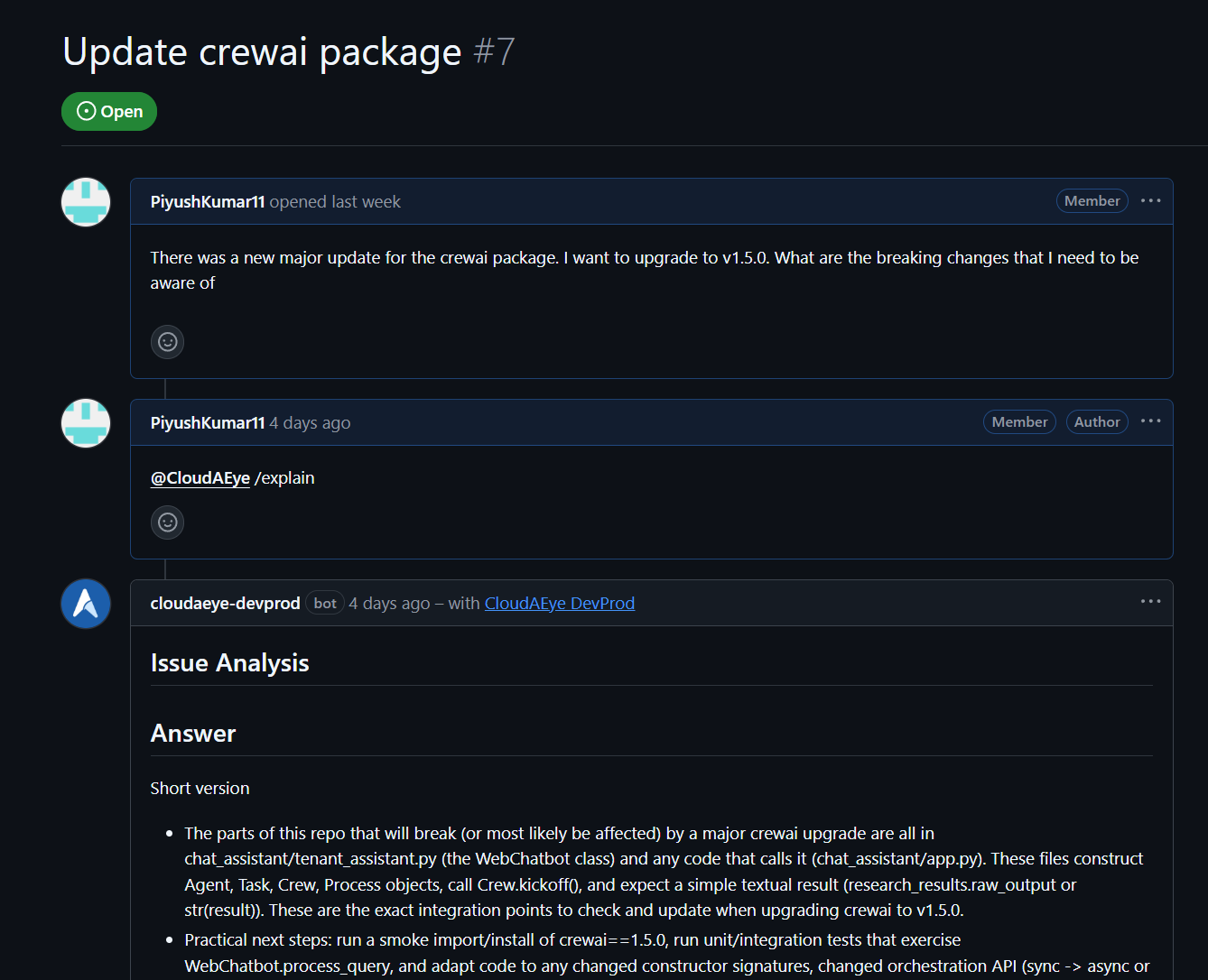
Generate docstrings, improve code readability, and maintain consistent documentation across the repository.
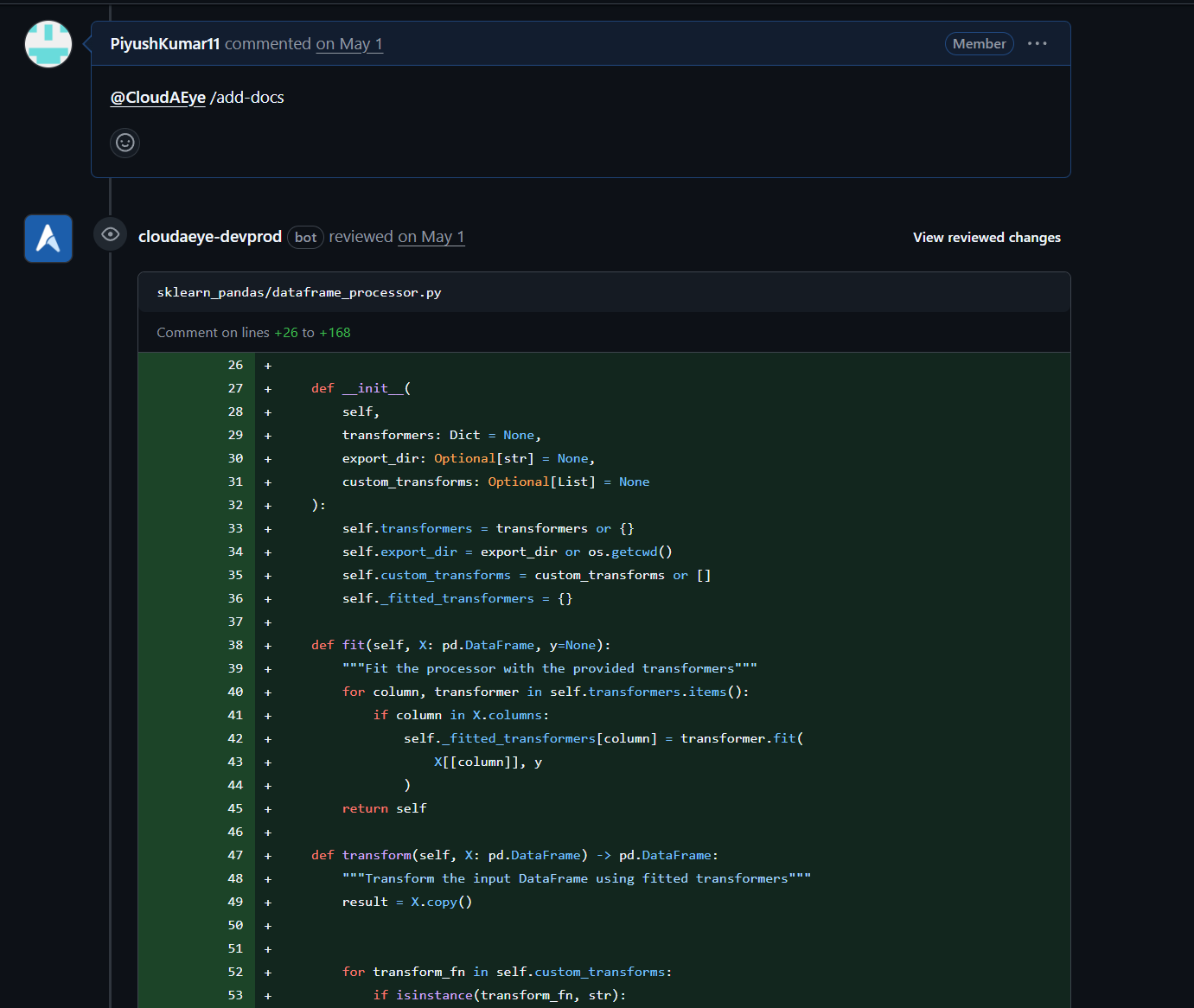
Engineering organizations using Bitbucket can now access the same depth of intelligence and automation previously available to GitHub users. This integration:
CloudAEye gives Bitbucket teams a modern, AI-driven development experience without the overhead of adopting new processes or rewriting existing pipelines.
CloudAEye for Bitbucket is available today. Teams can connect their Bitbucket workspace, enable automated reviews, and begin receiving high-context insights within minutes.
If your team is ready to elevate code quality, streamline dev-test workflows, and ship faster with confidence, CloudAEye is ready to help.
Get started today!

A seasoned engineering executive, Nazrul has been building enterprise products and services for 20 years. Nazrul is the founder and CEO of CloudAEye. Previously, he was Sr. Dir and Head of CloudBees Core where he focused on enterprise version of Jenkins. Before that, he was Sr. Dir of Engineering, Oracle Cloud. Nazrul graduated from the executive MBA program with high distinction (top 10% of the cohort) at University of Michigan Ross School of Business. Nazrul is named inventor in 47 patents.
July 17, 2026. 10 min
May 05, 2026. 15 min

Feb 24, 2026. 12 min
Dec 29, 2025. 10 min
May 28, 2025. 12 min

February 21, 2025. 8 min

Feb 04, 2025. 5 min
Dec 17, 2024. 10 min

December 24, 2024. 5 min

Jan 14, 2025. 5 min
February 18, 2025. 12 min
January 10, 2025. 7 min

January 31, 2025. 8 min

March 11, 2025. 8 min
Solutions by Use Case
Solutions by Role
Resources
Company