
CloudAEye

Review
Intelligence

Code review and governance,
inside your existing workflow.

Book a demo
01 / THE CHANGE

A new idempotency key changes retry behavior.

PR 1848 changes payment retry logic. System impact and related incident history warrant review by the Payments lead.

Auto-approveEligible low-risk changes.

Review requiredThe right owner takes a look.

Expert reviewCritical changes, expert-led.

Faster delivery. Slower reviews.
Greater production risk.

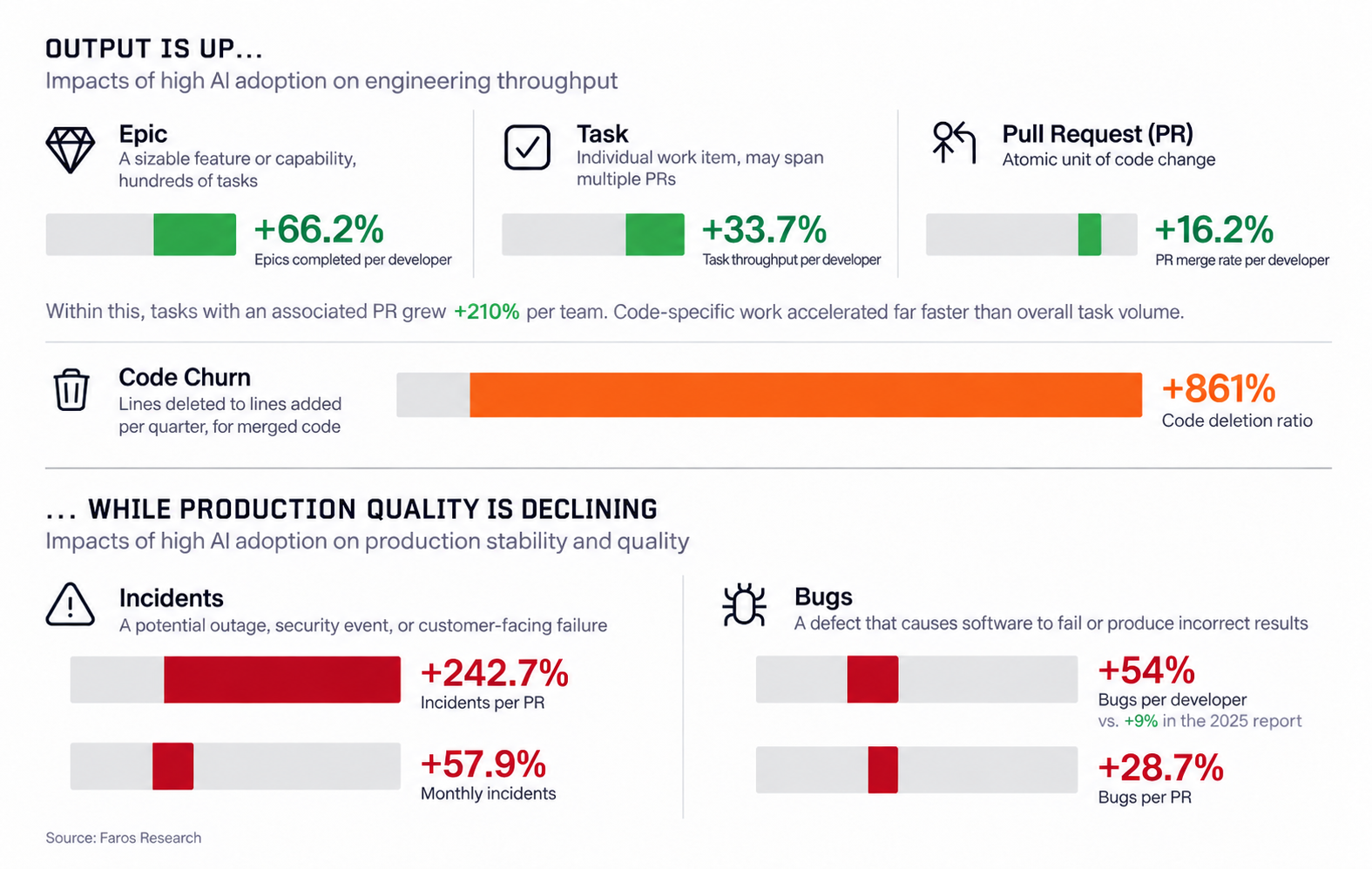
In Faros's study, higher AI adoption coincided with more completed work, but also longer reviews and a higher incidents-to-PR ratio. The delivery gains are real. So is the pressure on review.

AI ENGINEERING REPORT 2026 | KEY FINDINGS

The Acceleration Whiplash

Telemetry data from 22,000 developers on the real-world impact of AI adoption.

Faros Research: epics completed per developer increased 66.2%, task throughput per developer 33.7%, PR merge rate per developer 16.2%, code deletion ratio 861%, incidents per PR 242.7%, monthly incidents 57.9%, bugs per developer 54%, and bugs per PR 28.7%.
Adapted from Faros Research. Findings on engineering throughput and production quality.
Read the data
Relative increases between lower and higher AI adoption
Measure Increase
Epics completed per developer +66.2%
Task throughput per developer +33.7%
PR merge rate per developer +16.2%
Code deletion ratio +861%
Incidents per PR +242.7%
Monthly incidents +57.9%
Bugs per developer +54%
Bugs per PR +28.7%

An epic is a sizable feature or capability spanning hundreds of tasks. A task is an individual work item that may span multiple PRs. A pull request is an atomic unit of code change.

Tasks with an associated PR grew +210% per team. Code-specific work accelerated far faster than overall task volume.

Code deletion ratio measures lines deleted relative to lines added per quarter, for merged code. An incident is a potential outage, security event, or customer-facing failure. A bug is a defect that causes software to fail or produce incorrect results.

Bugs per developer increased +54%, compared with +9% in the 2025 report.

See the review intelligence before the merge.

CloudAEye connects risk, architecture, ownership, and policy so teams can prioritize consequential changes, involve the right reviewer, and check what must be verified before approval.

See how Review Intelligence helps

Faros research: 22,000 developers, 4,000+ teams, two years. Relative changes between each organization's lowest- and highest-adoption periods, not percentage-point changes. Observational findings, not proof of causation or CloudAEye customer results. The incident ratio is not an individual PR's failure probability.

Read Faros's findings ·

Govern code
at AI speed.

When review capacity is stretched, more comments are not enough. CloudAEye Review Intelligence brings risk, ownership, architecture, and policy checks into the review decision. Focus human attention on consequential changes, distribute reviews among qualified owners, and apply your standards before merge.

  • Prioritize the highest-impact PRs

    Put changes to critical paths, sensitive components, and incident-prone areas at the front of the review queue. Focus human attention on potential impact, not just diff size or arrival order.

  • Find the right reviewer. Balance the load.

    Match each PR to the human reviewer with the right domain knowledge and code ownership. Automatically balance the review load among qualified reviewers without trading away expertise.

  • Keep past incidents from becoming new bugs

    Bring production history into the review. Turn root causes into shared review rules and regression tests that help catch the same failure pattern before it ships again.

  • Review like an architect

    Trace changes beyond individual lines. Protect abstraction layers and dependency boundaries, and flag unexpected control flows or changes to critical execution paths.

  • Verify AI-generated code, not just its syntax

    Assess correctness, security, and maintainability alongside the AI slop score. Find logic defects, fabricated APIs, duplication, and unnecessary complexity, even when the code looks plausible.

  • Prove the new behavior. Protect the old.

    Check the PR against its task and acceptance criteria, then examine test coverage for affected existing features. Identify missing tests and regression risks before the change is approved.

Every decision has a reason.

Review Intelligence connects code, architecture, ownership, requirements, and incident history. The evidence explains which PR needs attention, who should review it, and what must be verified.

A small diff. A critical path.

This payment retry change touches checkout, the payment provider, and the ledger. Its critical path and related incident history make it a higher-priority review than its small diff suggests. Prioritize the potential impact, then route it to the Payments lead.

payments / retry.ts
- return charge(order, order.id);
+ const key = createAttemptId();
+ return charge(order, key);

Review focus: idempotency across retries.
Related precedent: INC-247 / Duplicate payment

75+ built-in checks.

Nine categories for consistent engineering standards. Choose the checks your teams need and apply them during every code review.

  • Pull Request Quality

    Meaningful titles and complete change descriptions.

  • Documentation & Readability

    Docstrings, current READMEs, clear code and consistent naming.

  • Code Correctness & Maintainability

    Validated inputs, safe error paths and less duplication.

  • Testing & Quality Assurance

    Coverage, edge cases, runtime safety and linting.

  • Dependencies & Packaging

    Dependency declarations and installation files kept in sync.

  • Security & Compliance

    Exposed secrets, injection risks, access controls and sensitive data.

  • LLM and Gen AI Apps Security

    Prompt injection, unsafe outputs and RAG weaknesses.

  • Agentic Security

    Poisoned memory, tool misuse and compromised agent permissions.

  • MCP Server

    Tool contracts, parameter validation, safe responses and action confirmation.

11 capabilities.
One informed decision.

Review Intelligence turns code quality, architecture, production history, and team context into actionable review evidence, from local changes in Claude Code to the pull request.

Review Completeness and Blocking Findings

No change advances while a critical finding is open. The configurable gate reads the whole set of review outputs the change is subject to: change description and PR checklist, bug report, OWASP security, LLM security, AI-agent security, MCP tool security, issue alignment, linting, secret scanning, and the final approved summary. Each must run to completion, with an option to block merge if any of them fails.

Issue/Task Alignment

Check the change against the issue/task it claims to implement. Every acceptance criterion has to map to evidence inside the change (a function, a line, a test), not to a claim in the commit message. The result is a DONE / NOT DONE verdict.

AI Slop Score

A reproducible 0–100 score for how much of the change is filler. Duplicated code, hallucinated or non-existent APIs, dead code, missing tests, high complexity, excessive nesting, generic naming, boilerplate comments, overengineering, overly defensive code, low-value wrappers, inconsistent style, superficial error handling, documentation mismatch, and suspicious commit patterns all contribute to the slop score.

Bug Trends and Code Area Stability

Prioritize PRs using the historical bug frequency and stability of the code they touch. A small change in an unstable or sensitive area can deserve more attention than a large, routine change. Surface that risk early and direct human review toward the highest impact work, before commit or approval.

Production Incident History

Check the production incident history of every component and product area touched by the local changes. Significant, severe, or recurring incidents increase the review requirement before the commit can proceed.

Control Flow Analysis

Reviews like an architect, not just a line by line checker. Compare the control flow introduced by the change with existing execution paths. Flag unexpected branches, unnecessary detours, and changes to critical paths so a passing syntax check does not hide a behavioral regression.

Architecture Analysis

Protect abstraction layers, dependency boundaries, and the design principles used across the repository and organization. Check whether new structures put responsibilities in the right layer, bypass an established interface, or introduce an unwanted dependency. Catch architectural drift while the change is still in Claude Code.

Model Inversion

Review the change with a different model family from the one that wrote it. Code written with Claude is reviewed by GPT; code written with GPT is reviewed by Claude. A model’s blind spots are systematic, and the cheapest way to avoid inheriting them in review is to not use the same model twice.

Requirements and Regression Testing

QA has two jobs: verify that the PR meets new requirements and check that it preserves existing behavior. A QA agent maps acceptance criteria to evidence, examines coverage for affected features, and generates missing tests, including regression cases. Pre-commit, tests land in the working tree. Post-PR, they arrive as one-click suggestions. Review the evidence for both new and existing behavior, not just a line coverage percentage.

Team History and Manager’s Decision

Consider the team’s historical AI-slop scores and overall delivery record inside the pre-commit decision. Consistently safe teams may qualify for automatic commit clearance, while a manager can require human review before any change is committed.

Incident-Driven Learning

Turn every production incident into a permanent gate. For each root cause, generate a regression test and a review rule, add both to a shared library the whole organization inherits, and enforce them everywhere a change is checked (pre-commit hook or pull request).

The next review
remembers this one.

Turn an incident's root cause into a regression test and a reusable review rule. Measure fewer repeat incidents, not just more rules.

Production incident

Duplicate payment

INC-247

Regression test

Retry without recharging

Protect the original failure path

Shared review rule

Preserve idempotency

Apply the learning to future changes